On Thu, Apr 28, 2016 at 05:44:21PM -0000, Tom Yan wrote:

CCing Keith Busch <[email protected]>, maintainer of QEMU NVMe.
Maybe he has an idea.
> Public bug reported:
>
> Full command: qemu-system-x86_64 -enable-kvm -cpu host -smp cores=4 -m
> 4G -net bridge -net nic -full-screen -drive
> file=ovmf_x64.bin,format=raw,if=pflash -drive
> file=disks/win16_ide.img,format=raw,cache=none,aio=native -drive
> file=disks/one.img,if=none,format=qcow2,id=one -drive
> file=disks/two.img,if=none,format=qcow2,id=two -device
> nvme,drive=one,serial=E86C3CFC43518D6F -device
> nvme,drive=two,serial=2BDAC262CF831698
>
> QEMU version: 2.5.0
>
> Kernel: 4.5.1 (Arch Linux)
>
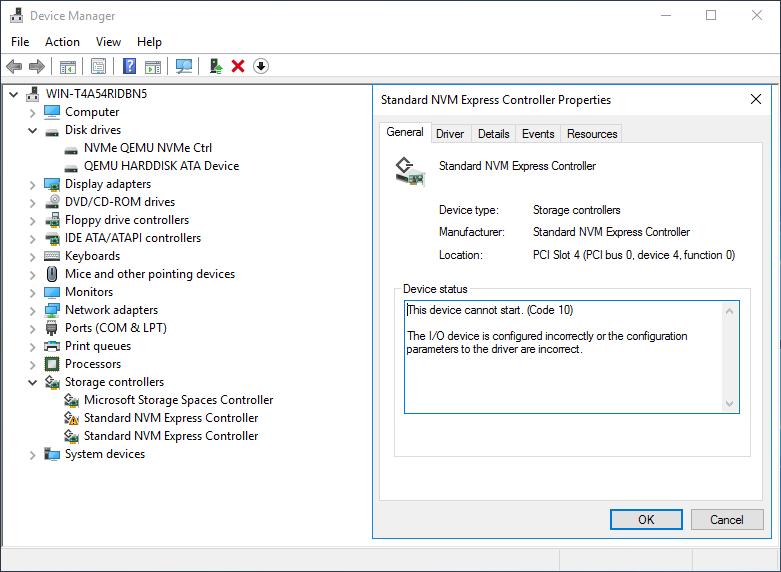
> When there are two NVMe devices specified, only the second one will be
> usable in Windows. The following error is shown under "Device status" of
> the failed NVMe controller in Device Manager:
>
> "This device cannot start. (Code 10)
>
> The I/O device is configured incorrectly or the configuration parameters
> to the driver are incorrect."
>
> The only thing seems suspicious to me is that the nvme emulation in qemu
> does not have WWN/EUI-64 set for the devices, though I have no idea at
> all whether that is mandatory:
>
> "C:\Windows\system32>sg_vpd -i PD1
> Device Identification VPD page:
>   Addressed logical unit:
>     designator type: SCSI name string,  code set: UTF-8
>       SCSI name string:
>       8086QEMU NVMe Ctrl                          00012BDAC262CF831698
>
> C:\Windows\system32>sg_vpd -p sn PD1
> Unit serial number VPD page:
>   Unit serial number: 0000_0000_0000_0000."
>
> ** Affects: qemu
>      Importance: Undecided
>          Status: New
>
> ** Attachment added: "Screenshot of Device Manager and the error."
>    https://bugs.launchpad.net/bugs/1576347/+attachment/4650548/+files/01.PNG
>
> --
> You received this bug notification because you are a member of qemu-
> devel-ml, which is subscribed to QEMU.
> https://bugs.launchpad.net/bugs/1576347
>
> Title:
>   Only one NVMe device is usable in Windows (10) guest
>
> Status in QEMU:
>   New
>
> Bug description:
>   Full command: qemu-system-x86_64 -enable-kvm -cpu host -smp cores=4 -m
>   4G -net bridge -net nic -full-screen -drive
>   file=ovmf_x64.bin,format=raw,if=pflash -drive
>   file=disks/win16_ide.img,format=raw,cache=none,aio=native -drive
>   file=disks/one.img,if=none,format=qcow2,id=one -drive
>   file=disks/two.img,if=none,format=qcow2,id=two -device
>   nvme,drive=one,serial=E86C3CFC43518D6F -device
>   nvme,drive=two,serial=2BDAC262CF831698
>
>   QEMU version: 2.5.0
>
>   Kernel: 4.5.1 (Arch Linux)
>
>   When there are two NVMe devices specified, only the second one will be
>   usable in Windows. The following error is shown under "Device status"
>   of the failed NVMe controller in Device Manager:
>
>   "This device cannot start. (Code 10)
>
>   The I/O device is configured incorrectly or the configuration
>   parameters to the driver are incorrect."
>
>   The only thing seems suspicious to me is that the nvme emulation in
>   qemu does not have WWN/EUI-64 set for the devices, though I have no
>   idea at all whether that is mandatory:
>
>   "C:\Windows\system32>sg_vpd -i PD1
>   Device Identification VPD page:
>     Addressed logical unit:
>       designator type: SCSI name string,  code set: UTF-8
>         SCSI name string:
>         8086QEMU NVMe Ctrl                          00012BDAC262CF831698
>
>   C:\Windows\system32>sg_vpd -p sn PD1
>   Unit serial number VPD page:
>     Unit serial number: 0000_0000_0000_0000."
>
> To manage notifications about this bug go to:
> https://bugs.launchpad.net/qemu/+bug/1576347/+subscriptions
>
 signature.asc
Description: PGP signature