junrushao commented on code in PR #363:
URL: https://github.com/apache/tvm-ffi/pull/363#discussion_r2655753938
##########
docs/concepts/tensor.rst:
##########
@@ -0,0 +1,486 @@
+..  Licensed to the Apache Software Foundation (ASF) under one
+    or more contributor license agreements.  See the NOTICE file
+    distributed with this work for additional information
+    regarding copyright ownership.  The ASF licenses this file
+    to you under the Apache License, Version 2.0 (the
+    "License"); you may not use this file except in compliance
+    with the License.  You may obtain a copy of the License at
+
+..    http://www.apache.org/licenses/LICENSE-2.0
+
+..  Unless required by applicable law or agreed to in writing,
+    software distributed under the License is distributed on an
+    "AS IS" BASIS, WITHOUT WARRANTIES OR CONDITIONS OF ANY
+    KIND, either express or implied.  See the License for the
+    specific language governing permissions and limitations
+    under the License.
+
+Tensor and DLPack
+=================
+
+At runtime, TVM-FFI often needs to accept tensors coming from many sources:
+
+* Frameworks (e.g. PyTorch, JAX) via :py:meth:`array_api.array.__dlpack__`;
+* C/C++ callers passing :c:struct:`DLTensor* <DLTensor>`;
+* Tensors allocated by a library but managed by TVM-FFI itself.
+
+TVM-FFI standardizes tensors on **DLPack as lingua franca**: they are
+built on top of DLPack's tensors with additional C++ convenience methods,
+and optional minimal extensions for ownership management.
+
+.. tip::
+
+  Always use :cpp:class:`tvm::ffi::TensorView` or
:cpp:class:`tvm::ffi::Tensor` in C++ code,
+  as they provide safer and more convenient abstractions over raw DLPack
structs.
+
+
+This tutorial is organized as follows:
+
+* **Tensor Classes**: introduces what tensor types are provided, and which one
you should use.
+* **Conversion between TVMFFIAny**: how tensors flow through ABI boundaries.
+* **Tensor APIs**: the most important tensor APIs you will use, including
allocation and stream handling.
+
+Glossary
+--------
+
+DLPack
+  A cross-library tensor interchange standard, written as a small pure C
header ``dlpack.h``.
+  It defines pure C data structures for describing n-dimensional arrays and
their memory layout,
+  including :c:struct:`DLTensor`, :c:struct:`DLManagedTensorVersioned`,
:c:struct:`DLDataType`,
+  :c:struct:`DLDevice`, and related types.
+
+View (non-owning)
+  A "header" that describes a tensor but does not own the tensor's memory.
When the consumer
+  receives a view, it must respect that the producer owns the underlying
storage and decides its
+  lifetime, and use the view can only be used when the producer guarantees it
remains valid.
+
+Managed object (owning)
+  An object that includes lifetime management. It involves reference counting
or a cleanup callback
+  mechanism, which establishes a contract between producer and consumer about
when consumer's ownership ends.
+
+.. note::
+
+  As a non-strict analogy, think of **view** vs. **managed** as similar to
+  ``T*`` (raw pointer) vs. ``std::shared_ptr<T>`` (reference-counted pointer)
in C++.
+
+Tensor Classes
+--------------
+
+This section defines each tensor type you will encounter in TVM-FFI C++ and
explains the
+*intended* usage. Exact C layout details are covered later in
:ref:`layout-and-conversion`.
+
+.. tip::
+
+  Python side, only :py:class:`tvm_ffi.Tensor` exists. It is strictly follows
DLPack semantics for interop, and can be converted to PyTorch via
:py:func:`torch.from_dlpack`.
+
+
+DLPack Tensors
+~~~~~~~~~~~~~~
+
+DLTensor has two main flavors:
+
+*Non-owning* object, :c:struct:`DLTensor`
+ The tensor is the fundamental tensor descriptor, and is a **view** of the
underlying data.
+ It describes the device the tensors lives, its shape, dtype, and data
pointer. It does not own the underlying data.
+
+*Owning* object, :c:struct:`DLManagedTensorVersioned`, or its legacy
counterpart :c:struct:`DLManagedTensor`
+ It is a **managed** variant that wraps :c:struct:`DLTensor` descriptor with a
few additional fields.
+ Notably, a ``deleter`` callback, which signals the release of ownership when
done with the tensor,
+ and an opaque ``manager_ctx`` handle used by by the producer to store
additional information.
+
+TVM-FFI Tensors
+~~~~~~~~~~~~~~~
+
+Similarly, TVM-FFI defines two main tensor types in C++:
+
+*Non-owning* object, :cpp:class:`tvm::ffi::TensorView`
+ A thin C++ wrapper around :c:struct:`DLTensor` for inspecting metadata and
accessing data pointer.
+ It is designed for **kernel authors** to inspect metadata and access the
underlying data pointer during the call,
+ without taking ownership of the tensor's memory. Being a **view** also means
you must ensure the backing tensor remains valid while you use the view.
+
+*Owning* object, :cpp:class:`tvm::ffi::TensorObj` and
:cpp:class:`tvm::ffi::Tensor`
+ :cpp:class:`Tensor <tvm::ffi::Tensor>`, similar to
``std::shared_ptr<TensorObj>``, is the managed class to hold heap-allocated
+ :cpp:class:`TensorObj <tvm::ffi::TensorObj>`. Once the reference count drops
to zero, the cleanup logic deallocates both the descriptor,
+ and returns the ownership of the underlying data buffer.
+
+
+.. note::
+
+   - For handwriting C++, always use TVM-FFI tensors over DLPack's raw C
tensors.
+
+   - For compiler development, DLPack's raw C tensors are recommended as C is
easier to target from codegen.
+
+The owning :cpp:class:`Tensor <tvm::ffi::Tensor>` is the recommended interface
for passing around managed tensors,
+and use owning tensors only when you need one or more of the following:
+
+* return a tensor from a function across ABI, which will be converted to
:cpp:class:`tvm::ffi::Any`;
+* allocate an output tensor as the producer, and hand it to a kernel consumer;
+* store a tensor in a long-lived object.
+
+.. admonition:: :cpp:class:`TensorObj <tvm::ffi::TensorObj>` vs
:cpp:class:`Tensor <tvm::ffi::Tensor>`
+   :class: hint
+
+   :cpp:class:`Tensor <tvm::ffi::Tensor>` is an intrusive pointer of a
heap-allocated :cpp:class:`TensorObj <tvm::ffi::TensorObj>`.
+   As an analogous example to shared pointer, think of
+
+   .. code-block:: cpp
+
+      using Tensor = std::shared_ptr<TensorObj>;
+
+   One could always convert between two types:
+
+   - :cpp:func:`Tensor::get() <tvm::ffi::Tensor::get>` converts it to
:cpp:class:`TensorObj* <tvm::ffi::TensorObj>`.
+   - :cpp:func:`GetRef\<Tensor\> <tvm::ffi::GetRef>` converts a
:cpp:class:`TensorObj* <tvm::ffi::TensorObj>` back to :cpp:class:`Tensor
<tvm::ffi::Tensor>`.
+
+.. _layout-and-conversion:
+
+Tensor Layouts
+~~~~~~~~~~~~~~
+
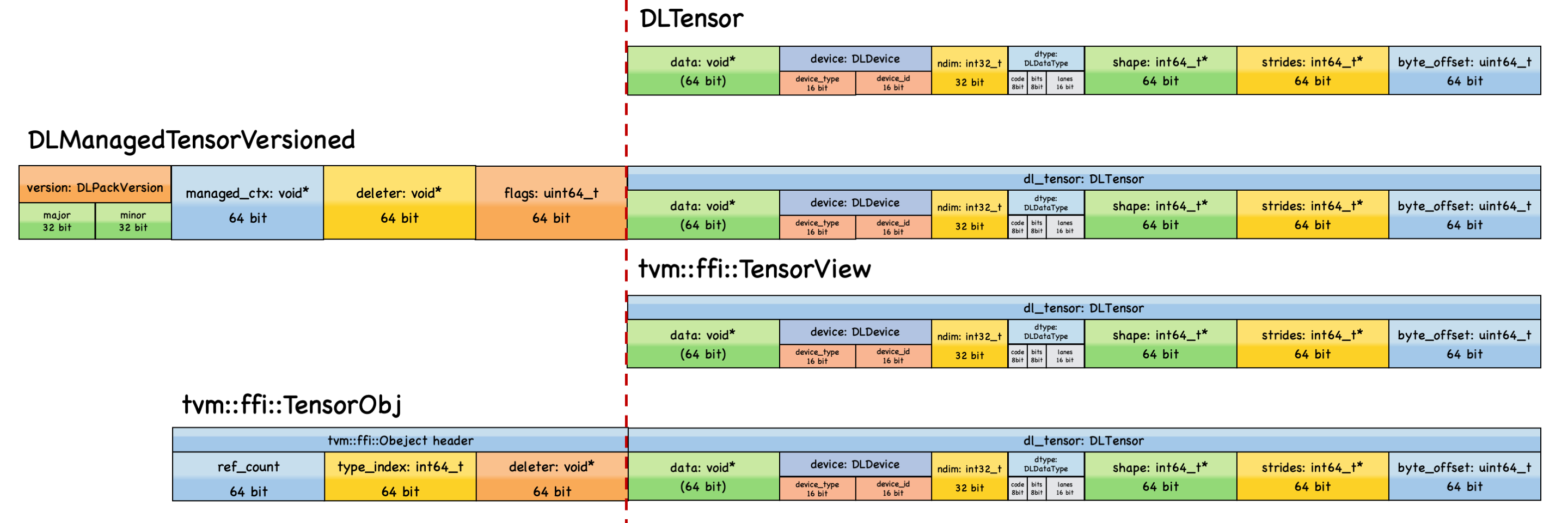
+:ref:`Figure 1 <fig:layout-tensor>` summarizes the layout relationships among
DLPack tensors and TVM-FFI tensors.
+All tensor classes are POD-like, while :cpp:class:`tvm::ffi::TensorObj` is
further a standard TVM-FFI object, usually
+heap-allocated and reference-counted.
+
+.. figure::
https://raw.githubusercontent.com/tlc-pack/web-data/main/images/tvm-ffi/tensor-layout.png
+  :alt: Layout of DLPack Tensors and TVM-FFI Tensors
+  :align: center
+  :name: fig:layout-tensor
+
+  Figure 1. Layout specification of DLPack tensors and TVM-FFI tensors. All
the tensor types share :c:struct:`DLTensor` as the common descriptor, while
carrying different metadata and ownership semantics.
+
+As demonstrated in the figure, all tensor classes share :c:struct:`DLTensor`
as the common descriptor,
+particularly,
+
+- :c:struct:`DLTensor` and :cpp:class:`TensorView <tvm::ffi::TensorView>`
share the exact same memory layout.
+- :c:struct:`DLManagedTensorVersioned` and :cpp:class:`TensorObj
<tvm::ffi::TensorObj>` both have a deleter
+  callback to manage the lifetime of the underlying data buffer, while
:c:struct:`DLTensor` and :cpp:class:`TensorView <tvm::ffi::TensorView>` do not.
+- Compared with :cpp:class:`TensorView <tvm::ffi::TensorView>`,
:cpp:class:`TensorObj <tvm::ffi::TensorObj>`
+  has an extra TVM-FFI object header, making it reference-countable in
standard TVM-FFI managed reference :cpp:class:`Tensor <tvm::ffi::Tensor>`.
+
+What Tensor is not
+~~~~~~~~~~~~~~~~~~
+
+TVM-FFI is not a tensor library. While presenting a unified standardized
representation to tensors,
+it does not come with any of the following:
+
+* kernels, such as vector addition, matrix multiplication;
+* host-device copy or synchronization primitives;
+* advanced indexing or slicing;
+* automatic differentiation or computational graph support.
+
+Conversion between :cpp:class:`TVMFFIAny`
+-----------------------------------------
+
+At the stable C ABI boundary, TVM-FFI passes values using an "Any-like"
carrier, often referred
+to as :cpp:class:`Any <tvm::ffi::Any>` (owning) or :cpp:class:`AnyView
<tvm::ffi::AnyView>` (non-owning).
+These are 128-bit tagged unions derived from :cpp:class:`TVMFFIAny` that
contain:
+
+* a :cpp:member:`type_index <TVMFFIAny::type_index>` that indicates the type
of the payload, and
+* a union payload that may contain:
+
+  * A1. Primitive values, such as integers, floats, enums, raw pointers, or
+  * A2. TVM-FFI object handles, which are reference-counted pointers.
+
+For tensors stored in :cpp:class:`Any <tvm::ffi::Any>` or :cpp:class:`AnyView
<tvm::ffi::AnyView>` specifically,
+there are two possible representations:
+
+* Non-owning views as A1 (primitive values), i.e. :c:struct:`DLTensor*
<DLTensor>` whose type index is
:cpp:enumerator:`TVMFFITypeIndex::kTVMFFIDLTensorPtr`.
+* Owning objects as A2 (TVM-FFI tensor object handles), i.e.,
:cpp:class:`TensorObj* <tvm::ffi::TensorObj>` whose type index is
:cpp:enumerator:`TVMFFITypeIndex::kTVMFFITensor`.
+
+Therefore, when you see a tensor in :cpp:class:`Any <tvm::ffi::Any>` or
:cpp:class:`AnyView <tvm::ffi::AnyView>`,
+you must first check its :cpp:member:`type_index <TVMFFIAny::type_index>` to
determine if it is a raw pointer or an object handle,
+before converting it to the desired tensor type.
+
+.. important::
+
+  As a general rule of thumb, an owning object can be converted to a
non-owning view, but not vice versa.
+
+To Non-Owning Tensor
+~~~~~~~~~~~~~~~~~~~~
+
+This converts an owning :cpp:class:`Any <tvm::ffi::Any>` or non-owning
:cpp:class:`AnyView <tvm::ffi::AnyView>` into a non-owning tensor.
+Two type indices can be converted to a non-owning tensor view:
+
+- :cpp:enumerator:`TVMFFITypeIndex::kTVMFFIDLTensorPtr`: the payload is a raw
pointer :c:struct:`DLTensor* <DLTensor>`.
+- :cpp:enumerator:`TVMFFITypeIndex::kTVMFFITensor`: the payload is a TVM-FFI
tensor object handle, from which you can extract the underlying
:c:struct:`DLTensor` according to the layout defined in :ref:`Figure 1
<fig:layout-tensor>`.
+
+The snippets below are plain C (C99-compatible) and assume the TVM-FFI C ABI
definitions from
+``tvm/ffi/c_api.h`` are available.
+
+.. code-block:: cpp
+
+    // Converts Any/AnyView to DLTensor*
+    int AnyToDLTensorView(const TVMFFIAny* value, DLTensor** out) {
+      if (value->type_index == kTVMFFIDLTensorPtr) {
+        *out = (DLTensor*)value->v_ptr;
+        return SUCCESS;
+      }
+      if (value->type_index == kTVMFFITensor) {
+        // See Figure 1 for layout of tvm::ffi::TensorObj
+        TVMFFIObject* obj = value->v_obj;
+        *out = (DLTensor*)((char*)obj + sizeof(TVMFFIObject));
+        return SUCCESS;
+      }
+      return FAILURE;
+    }
+
+:cpp:class:`TensorView <tvm::ffi::TensorView>` can be constructed directly
from the returned :c:struct:`DLTensor* <DLTensor>`.
+
+To Owning Tensor
+~~~~~~~~~~~~~~~~
+
+This converts an owning :cpp:class:`Any <tvm::ffi::Any>` or non-owning
:cpp:class:`AnyView <tvm::ffi::AnyView>` into an owning :cpp:class:`TensorObj
<tvm::ffi::TensorObj>`. Only type index
:cpp:enumerator:`TVMFFITypeIndex::kTVMFFITensor` can be converted to an owning
tensor, as it contains a TVM-FFI tensor object handle. The conversion involves
incrementing the reference count to take ownership.
+
+.. code-block:: cpp
+
+    // Converts Any/AnyView to TensorObj*
+    int AnyToOwnedTensor(const TVMFFIAny* value, TVMFFIObjectHandle* out) {
+      if (value->type_index == kTVMFFITensor) {
+        *out = (TVMFFIObjectHandle)value->v_obj;
+        return SUCCESS;
+      }
+      return FAILURE;
+    }
+
+The caller can obtain shared ownership by calling
:cpp:func:`TVMFFIObjectIncRef` on the returned handle,
+and later release it with :cpp:func:`TVMFFIObjectDecRef`.
+
+From Owning Tensor
+~~~~~~~~~~~~~~~~~~
+
+This converts an owning :cpp:class:`TensorObj <tvm::ffi::TensorObj>` to an
owning :cpp:class:`Any <tvm::ffi::Any>` or non-owning :cpp:class:`AnyView
<tvm::ffi::AnyView>`. It sets the type index to
:cpp:enumerator:`TVMFFITypeIndex::kTVMFFITensor` and stores the tensor object
handle in the payload.
+
+.. code-block:: cpp
+
+    // Converts TensorObj* to AnyView
+    int TensorToAnyView(TVMFFIObjectHandle tensor, TVMFFIAny* out_any_view) {
+      out_any_view->type_index = kTVMFFITensor;
+      out_any_view->zero_padding = 0;
+      out_any_view->v_obj = (TVMFFIObject*)tensor;
+      return SUCCESS;
+    }
+
+    // Converts TensorObj* to Any
+    int TensorToAny(TVMFFIObjectHandle tensor, TVMFFIAny* out_any) {
+      assert (out_any->type_index == kTVMFFITypeIndexNone);
+      out_any->type_index = kTVMFFITensor;
+      out_any->zero_padding = 0;
+      out_any->v_obj = (TVMFFIObject*)tensor;

Review Comment:
   Good catch!


--
This is an automated message from the Apache Git Service.
To respond to the message, please log on to GitHub and use the
URL above to go to the specific comment.

To unsubscribe, e-mail: [email protected]

For queries about this service, please contact Infrastructure at:
[email protected]


---------------------------------------------------------------------
To unsubscribe, e-mail: [email protected]
For additional commands, e-mail: [email protected]