Hello,
I am not a scholar but i wrote the following program in Prolog.

It works on B-Prolog and on SWI prolog but it always crash in GNU prolog.

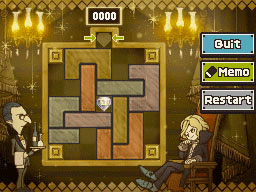
The program is the solution of one Professor Layton's enigma :

http://www.professeur-layton.info/destin-perdu/files/2010/10/professeurlayton3-PC-S00.jpg

I am not sure that i made a good job but it works in some other prolog
implementation.

here is the source :

%************************************ DATA
piece(0, [(4, -1), (0, 0), (1, 0), (2, 0), (3, 0), (5, 0), (6, 0), (7, 0),
(8,0), (0, 1), (0, 2), (0, 3), (0, 4), (0, 5), (0, 6), (0, 7), (0, 8), (8,
1), (8, 2), (8, 3), (8, 4), (8, 5), (8, 6), (8, 7), (8, 8), (1, 8), (2,
8), (3, 8), (4, 8), (5, 8), (6, 8), (7, 8), (1, 1), (7, 1), (1, 7), (7,
7)]). %the container box
piece(1, [(0, 0), (1, 0), (2, 0), (0, 1), (2, 1)]).
piece(2, [(0, 0), (0, 1), (0, 2)]).
piece(3, [(0, 0), (1, 0), (2, 0)]).
piece(4, [(0, 0), (1, 0), (1, 1), (0, 2), (1, 2)]).
piece(5, [(0, 0), (1, 0), (0, 1)]).
piece(6, [(0, 0), (1, 0), (2, 0)]).
piece(7, [(0, 0), (0, 1), (0, 2)]).
piece(8, [(1, 0), (1, 1), (1, 2), (0, 2)]).
piece(9, [(0, 0), (1, 0)]).
piece(10, [(0, 0), (0, 1)]).
piece(11, [(0, 0)]). %the diamond
confInit([(0,0,0),(1,4,1),(2,2,1),(3,5,3),(4,6,4),(5,4,4),(6,1,6),(7,3,1),(8,4,5),(9,2,7),(10,2,4),(11,3,4)]).
solution(11, 4, 1).
%*********************************** PROGRAM
move(up, 0, -1).
move(right, 1, 0).
move(down, 0, 1).
move(left, -1, 0).

calcPos([], _, []).
calcPos([(PX1, PY1)|L], (ATx, ATy), [(PX_RES, PY_RES)|L_RES]) :-
        PX_RES is PX1 + ATx,
        PY_RES is PY1 + ATy,
        calcPos(L, (ATx, ATy), L_RES).

isAnyCommon(L1, L2) :-
        member(X, L1),
        member(X, L2), !.

isOverlapsSub((P1, X1, Y1), (P2, X2, Y2)) :-
        piece(P1, LP1),
        piece(P2, LP2),
        calcPos(LP1, (X1, Y1), LP1prime),
        calcPos(LP2, (X2, Y2), LP2prime),
        isAnyCommon(LP1prime, LP2prime).

isOverlaps(P1info, CONF) :-
        select(P2info, CONF, _),
        isOverlapsSub(P1info, P2info), !.

action((LM, CONF), ([(P, M)|LM], [Pprime|CONF_RES])) :-
        select((P, Px, Py), CONF, CONF_RES),
        P =\= 0, %0 is the container (static)
        move(M, INCx, INCy),
        Px_prime is Px + INCx,
        Py_prime is Py + INCy,
        Pprime = (P, Px_prime, Py_prime),
        \+ isOverlaps(Pprime, CONF_RES).

actionBagof(CONF, ALL_CONF) :-
        bagof(RES, action(CONF, RES), ALL_CONF).

histoPurge([], []).
histoPurge([(M, CONF1)|LCONF], [(M, CONF1prime)|LCONFres]) :-
        sort(CONF1, CONF1prime),
        \+ histo(CONF1prime), !,
        asserta(histo(CONF1prime)),
        histoPurge(LCONF, LCONFres).
histoPurge([_|LCONF], LCONFres) :-
        histoPurge(LCONF, LCONFres).

soluceSub([], []).
soluceSub([X|LCONF], RES) :-
        actionBagof(X, LCONFprime),
        histoPurge(LCONFprime, LCONFsecond),
        append(LCONFsecond, INTER, RES),
        soluceSub(LCONF, INTER).

soluceFound([], _) :- !, fail.
soluceFound([(RES, Lconf)|_], (RES, Lconf)) :-
        solution(Psol, Px, Py),
        member((Psol, Px, Py), Lconf), !.
soluceFound([_|L], RES) :-
        soluceFound(L, RES).

soluce(INIT, RES) :-
        asserta(tree(INIT)),
        repeat,
        retract(tree(LCONF)),
        soluceSub(LCONF, LRES),
        asserta(tree(LRES)),
        retract(rec(REC)),
        RECprime is REC + 1,
        length(LRES, LEN),
        asserta(rec(RECprime)),
        print(RECprime + LEN),nl,
        ((LRES = [], !, fail) ; soluceFound(LRES, RES)).

%(0,0,0) always : it's the container of the pieces.
main :-
        confInit(CONF),
        INIT = ([], CONF),
        asserta(tree(x)),
        retractall(tree(_)),
        asserta(histo(x)),
        retractall(histo(_)),
        asserta(rec(0)),
        retractall(rec(_)),
        asserta(rec(0)),!,
        soluce([INIT], RES),
        print(RES).


Best regards.

Cordialement


Fabrice BIZEC
 | Synergie Informatique
50 Rue Tudelle 45100 Orléans

Tél  +33 2 38 56 52 51 | Fax +33 2 38 56 34 41 | 0606983999
[email protected]

 Actualités  |  Twitter |  Viadéo |   Youtube  |    Linkedin  |  Slideshare  |
Pinterest

Envoyé depuis mon client IBM Notes :  9.0.1


Adoptez l'éco-attitude, n'imprimez cet e-mail que si nécessaire
_______________________________________________
Bug-prolog mailing list
[email protected]
https://lists.gnu.org/mailman/listinfo/bug-prolog